




Basque Ministry for Sustainable Mobility and Correos unveil a stamp to mark the centenary of the Larreineta funicular railway as the driving force of the social and economic transformation of Trapagaran and La Arboleda
- Larreineta Funicular Railway / Larreinetako Funikularra 1926-2026 TUSELLO pays tribute to the first century of this unique means of transport run by Euskotren
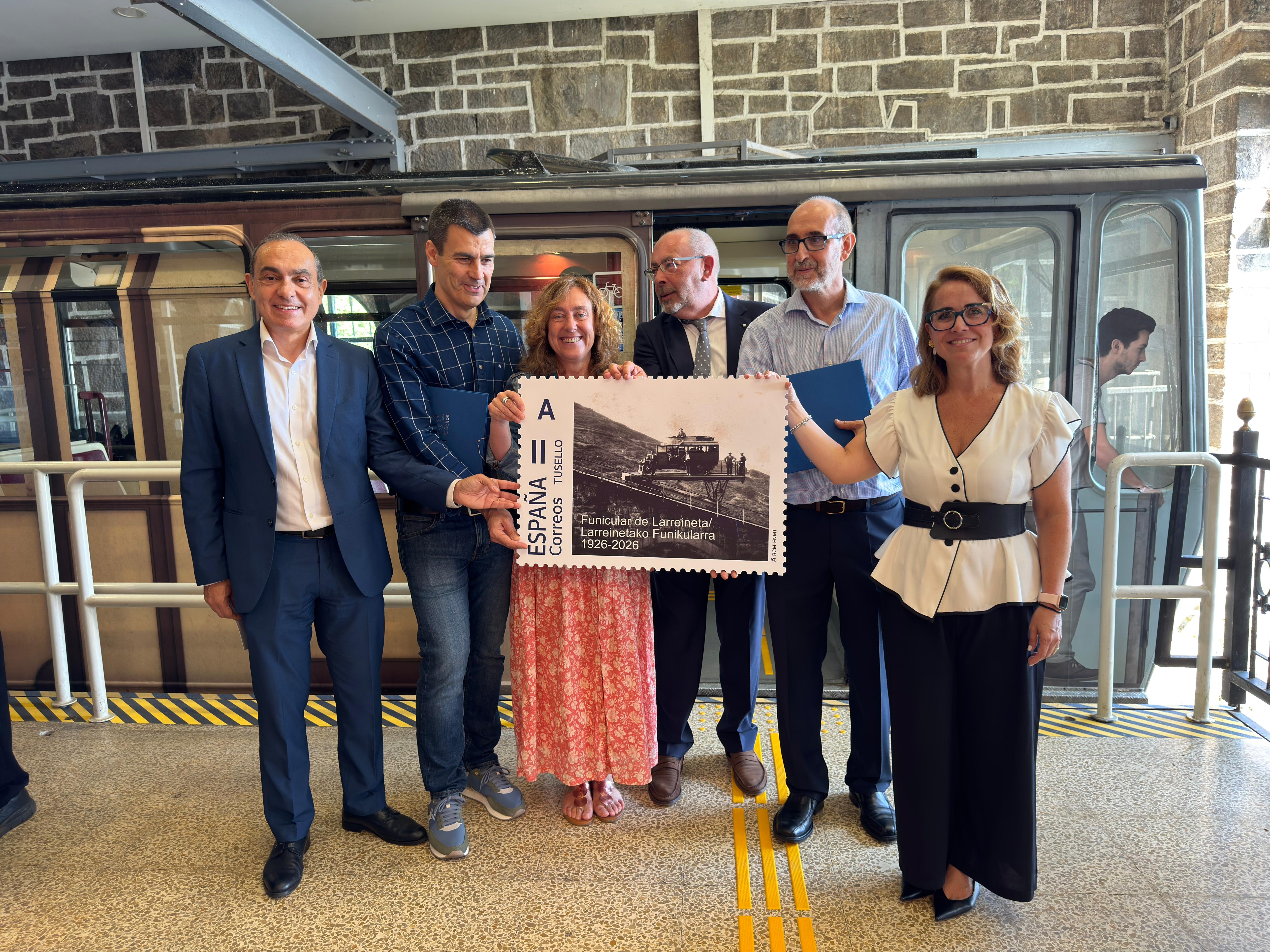
The Basque Ministry of Sustainable Transport and Correos [the Spanish Post Office] have today unveiled TUSELLO, a new personalised stamp of legal tender; it has been released as part of the commemorative acts to mark the centenary of the Larreineta Funicular railway and in tribute to the transformative value that this means of transport – and the only one of its kind in Europe – has had in the social and economic development of Trapagaran and La Arboleda.
Minister Susana García Chueca and Nuria Lera Hervás, the Director of Philately and International Relations at Correos, applied the honorary postmark, in the presence of the Mayor of Trapagaran, Miguel Ángel Gómez Viar; the Basque Deputy Minister for Infrastructures and Sustainable Mobility, Miguel Ángel Páez; the Director of Euskotren, Javier Seoane; and the Director of the Basque Railway Museum, Juanjo Olaizola. The ceremony took place at the upper station of the funicular (Larreineta), after the visit to the lower station – La Escontrilla – where they opened a permanent exhibition with historical photographs to showcase the evolution of this unusual means of transport.
The Larreineta funicular railway, a symbol of Basque industrial heritage and declared an Asset of Cultural Interest in 2014, is unique in Europe thanks to its horizontal platform design. Its specific construction features would transform the social and mining life of La Arboleda and Trapagaran right from when it came into service on 24 September 1926. The use of funicular has evolved over the last hundred years, but the passing of time has not prevented it from continuing to serve the public. It was formerly used by the miners and to transport the iron ore from La Arboleda quarry to the factories; now that the zone is net-zero, the funicular is a sustainable means of transport, managed by Euskotren, to make travel more convenient for local residents and for tourists to access a green area with large leisure and recreational spaces.
‘Marking the centenary is not only a tribute to the history of the funicular railway, but also to its contemporary importance and to its journey into the future, as a clear example of how it is possible to transition from a highly polluting economy, as was the carbon era, to another sustainable and clean one’ – stressed Minister Susana García Chueca – in line with the European Green Deal to be climate neutral by 2050.
‘Since 1926, the Larreineta funicular railway has been a symbol of identity, effort and progress; an essential infrastructure that has shored up the territory and the life of generations throughout its history. As part of its centenary celebrations, the issuing of this TUSELLO stamp highlights its legacy and its importance as living heritage. From Correos, through its Philately department, we are helping to preserve and disseminate this collective memory, by turning such an iconic element into a tangible account for citizens to learn about its history and to bolster the recognition of our cultural heritage,’ explained Nuria Lera Hervás, the Director of Philately and International Relations at Correos.
In turn, the Mayor of Trapagaran, Miguel Ángel Gómez Viar, thanked Correos and the Basque Government for their willingness to ‘showcase the best known symbol of our town and to issue a personalised stamp to record for the ages this first century of our beloved Larreineta funicular railway’.
The Larreineta funicular will also debut completely refurbished carriages in the year of its centenary. Their refurbishing, which is now in its final stretch, seeks to provide greater travel comfort and convenience for passengers and for the Euskotren staff, so that the funicular can continue to offer quality public transport for the residents of Larreineta and La Arboleda and for visitors, as it has been doing continuously for a hundred years.
Euskotren is using a novel technical solution precisely to ensure that the funicular service is not disrupted during the work. It consists of replacing the first carriage while it has been in the workshop by a modified maritime container, with a front windscreen and fitted out with a fully functional driving position so the driver can oversee the journey and act if necessary. The container is not used to transport passengers; therefore, the funicular has been operating since February with a single carriage and a modified timetable while the work continues.
Tribute will be paid to the importance of the funicular with a series of actions throughout 2026. These include the publication of an illustrated book – coordinated by the Euskotren Museum director, Juanjo Olaizola, and illustrated by the local designer Amaia Ballesteros –, different informative talks, recreational and festive events, and improving the current exhibition areas. A comic will also be published and guided tours organised for schools in order to reach a younger audience.
Characteristics of the stamp
The Correos stamp features one of the older images of the funicular. The black and white photography shows a bus being transported with some passengers inside. A person is nonchalantly travelling on the vehicle’s roof, which must have been usual, while others are standing on the platform. They are all looking at the camera that is capturing them for posterity.
This tribute stamp highlights the uniqueness of this centenarian means of transport: it was designed to be able to transport passengers and goods; its crane system is unique in the world and could be used to remove the passenger carriages to leave an open platform to transport any type of vehicles (as can be seen in the centre of the stamp).
While the vast majority of mountain railways were designed to take tourists up to the high summits to enjoy the breathtaking views, the Larreineta funicular aimed to meet the needs of the large mining population that lived and worked in the Trapagaran upland area in the early 20th century. That area was cut off from the outside world and the only means to reach it was along a winding road that took nearly an hour and a half to reach the centre of the town; the funicular meant that they could travel there quickly and safely in barely ten minutes. The issuing of the stamp precisely commemorates how important this transformation was for the society and surrounding area.
The Larreineta funicular railway with its 1,179 metres of track was the longest in the whole of Spain for 75 years. The gradient between its two stations is over 342 metres and its ramps reach 36%. Its designed opted for a track gauge of 1,200 millimetres, instead of the metric gauge that was standard for this type of facilities at that time, to give the system greater stability.
The Larreineta funicular railways has practically all its original facilities from 1926 intact: stations, machinery, viaducts and vehicles. The Basque Government therefore declared it an Asset of Cultural Interest in 2014, as it is one of the last and most iconic testimonies of the mining past of a region that, as few others, paved the way for the development of the modern Basque Country. Philately encapsulates in a small format any aspect that society considers important and worthy of recognition; the first centenary of this means of transport is now also part of this world.
The stamp can be purchased from the Trapagaran post office and by contacting the Philatelic Service at cliente.filatelia@correos.com or by calling 915 197 197.
Characteristics of the stamp
Reason: Larreineta Funicular Railway/Larreinetako Funikularra 1916-2026
Issue date: 15 June 2026
Printing procedure: at that time
Support: Fluorescent self-adhesive
Stamp size: 40.9 mm x 28.8 mm (horizontal)